A government or semi-government event MC in Dubai needs a controlled brief and a clear approval route. I prepare the names, titles, acknowledgements, English and Arabic wording, stage cues, and transitions I have been asked to deliver. I do not turn that preparation into a claim that I set the protocol.
The difference is visible in small moments. A title changes after the script has been printed. A guest enters by a different route. The Arabic opening has one approved form and the English line must carry the same meaning. The room needs an MC who can stay warm and composed while treating those details as exact show information.
What makes formal government hosting different?
Formal hosting places the MC inside a tighter chain of approved information. Names, titles, order of acknowledgement, language, national-symbol cues, seating references, media notes, and live changes may each have a specific owner. The MC's job is to learn that plan, rehearse it, and deliver it without freelancing around it.
Dubai's Protocol Department describes its role as managing local and international protocol for Dubai's leadership, ruling family, VIPs, and official visitors. Its published protocol activities also show why precedence affects introductions, seating, gifting, and ceremony. For a planner, the practical lesson is simple: use the event's authorised protocol route. Do not ask the MC to infer official order from a website, seating plan, or previous event.
The brief I need before I write
I can start with an imperfect programme, but I need to know where approval comes from. Before I write, I ask the planner to confirm:
- The event's purpose, commissioning body, and level of formality
- The source of approved names, titles, spoken forms, and acknowledgement order
- Which sections are Arabic, English, bilingual, or interpreted
- Which lines are fixed, and where I may adapt the tone or transition
- Who owns the current run of show, graphics, speaker list, access plan, and live-change channel
- What must be rehearsed in the room rather than confirmed by email
I build my working script from that approved material. Pronunciation cues, pauses, breath marks, and sightline notes help me deliver it, but never change the line's authority.
One approval map for the stage
The planner does not need a large responsibility manual. This compact map is enough to stop the most common confusion:
- Stage material
- Official names, titles, and spoken forms
- Who confirms it
- Client protocol office or authorised liaison
- How I use it
- Mark pronunciation and deliver the approved form
- Stage material
- Acknowledgement and introduction order
- Who confirms it
- Event-specific protocol authority
- How I use it
- Follow the current order and wait for the cue
- Stage material
- English and Arabic wording
- Who confirms it
- Named content and language approvers
- How I use it
- Prepare both versions without adding unapproved meaning
- Stage material
- National-symbol and ceremonial cues
- Who confirms it
- Protocol, production, and venue leads
- How I use it
- Rehearse the exact position, timing, and audience instruction
- Stage material
- Live programme changes
- Who confirms it
- Producer or show caller through one agreed channel
- How I use it
- Update the working script and deliver only the confirmed change
This is the only ownership table I want in the post because each row answers a real planner question. Everything else belongs in the live brief.
Names, titles, and acknowledgements
I treat a formal name as spoken show data. The best source is the event's approved list, supported by an audio reference when pronunciation is not obvious. I do not assume that a public profile carries the current title or that the English spelling tells me how the guest wants the name said in Arabic.
My preparation sheet records the approved written form, spoken form, a phonetic cue, language, and programme position. My name-pronunciation method explains how I turn that information into something I can use at speed. If a title changes, I want the update beside the run-of-show change, not in a separate message thread.
Acknowledgements need the same discipline. The official team decides who is named, in what order, and whether the Arabic and English versions repeat or divide the information. I focus on pace and clarity so the sequence sounds respectful rather than mechanical.
English and Arabic as one programme
Bilingual formal hosting is not a sentence-by-sentence translation exercise. One section may open in Arabic and move into English. A senior guest may require an approved Arabic acknowledgement while the main panel runs in English. Interpretation may carry specialist content while I keep the stage transitions concise.
I ask the language approvers to confirm meaning, formality, titles, and any wording that must remain fixed. Then I rehearse the switch points aloud. A language plan that looks balanced on paper can feel slow in the room if every line is repeated without a reason.
For the wider planning decision, my bilingual MC guide explains how to decide whether the programme needs English, Arabic, interpretation, or a mixed format. In a formal public event, that choice must also fit the approved protocol and audience plan.
Rehearse the ceremony, not only the script
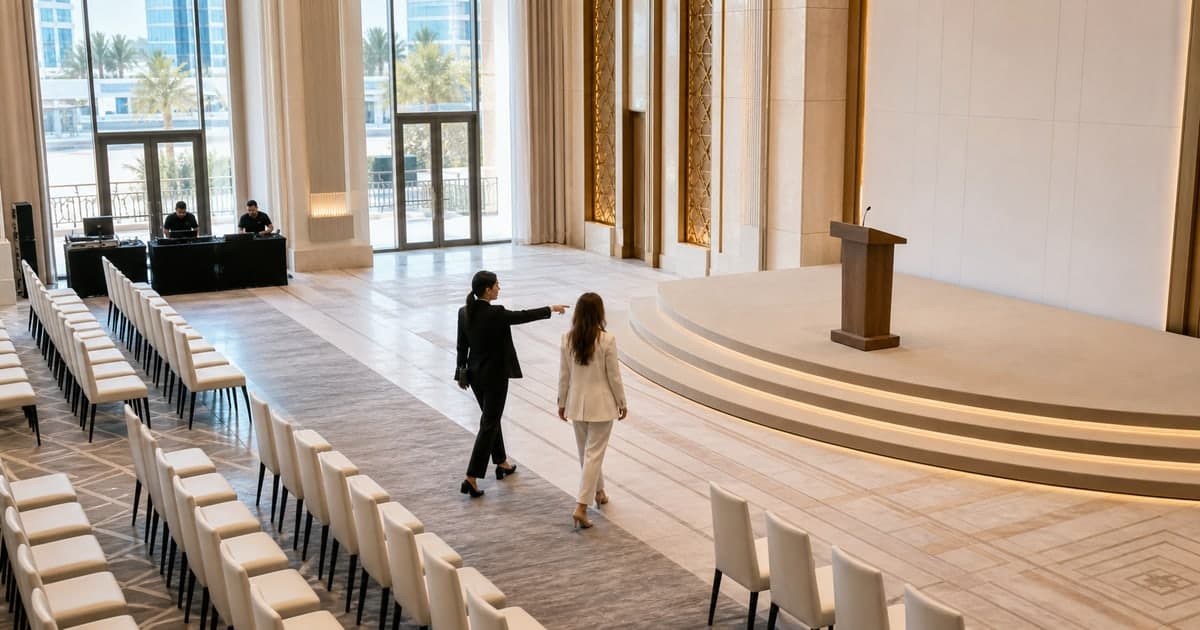
The real room changes how formal copy feels. I rehearse the walk-on route, sightline to the cue point, microphone position, lectern height, screen content, applause gap, interpretation delay, and the distance between the stage and the people I am acknowledging.
National-symbol moments receive their own cue. The Protocol Department's page on the UAE flag describes the flag as a symbol of nationalism, independence, and sovereignty that commands respect at official and public events. I follow the event team's approved treatment, audience instruction, timing, and production cue. I do not create a ceremony rule from the microphone.
Access belongs in the same rehearsal. Captions, interpretation, hearing support, step-free stage movement, and reserved audience routes should work with the live programme, not sit in a separate document that nobody tests from the stage.
I also rehearse the late-change route. If a title is corrected or an acknowledgement moves, I need one person to give me the final wording and one place to mark it. Graphics, interpretation, stage management, and the MC should receive the same approved version. A whispered update at the lectern is too easy to mishear.
What planners should ask to see
Relevant proof matters more than a general showreel. Ask the MC for a formal-stage sample that resembles the language, pace, and level of control your event needs. Then ask how the MC prepares names, receives script changes, works with the producer, and rehearses the room.
Listen beyond confidence. Does the MC give an official title enough space? Is the Arabic right for the brief? Does the English sound natural? Can the MC explain what needs approval and what can still be shaped for the audience? Those answers reveal more than a fast montage of applause.
The strongest formal hosting often looks effortless from the seats. Backstage, it comes from exact information, one current version, a real rehearsal, and an MC who knows where preparation ends and authority begins.
Rima Iskandarani
Professional bilingual Events MC based in Dubai with 10+ years of experience hosting 150+ corporate, government, and entertainment events across the GCC.
Related Articles
Event Planning
Bilingual MC in Dubai: English and Arabic Event Hosting
A bilingual MC in Dubai plans when English, Arabic, or both will serve the audience and keeps the program moving without repeating every line.
Hiring an MC
How to Choose the Right Corporate Event MC in Dubai
Rima explains how to choose a corporate event MC in Dubai by matching the host to the room, audience, format, moderation, language, rehearsal, and production brief.
Event Planning
What Does a Professional Event MC Actually Do?
A professional event MC guides the audience-facing program while coordinating timing, speakers, transitions, and live changes with the event team.
MC Stories
How I Prepare for Technical Industry Events as an MC
Rima explains how she prepares for a technical event: understand the audience, learn approved terminology, rehearse names and transitions, and respect expert boundaries.