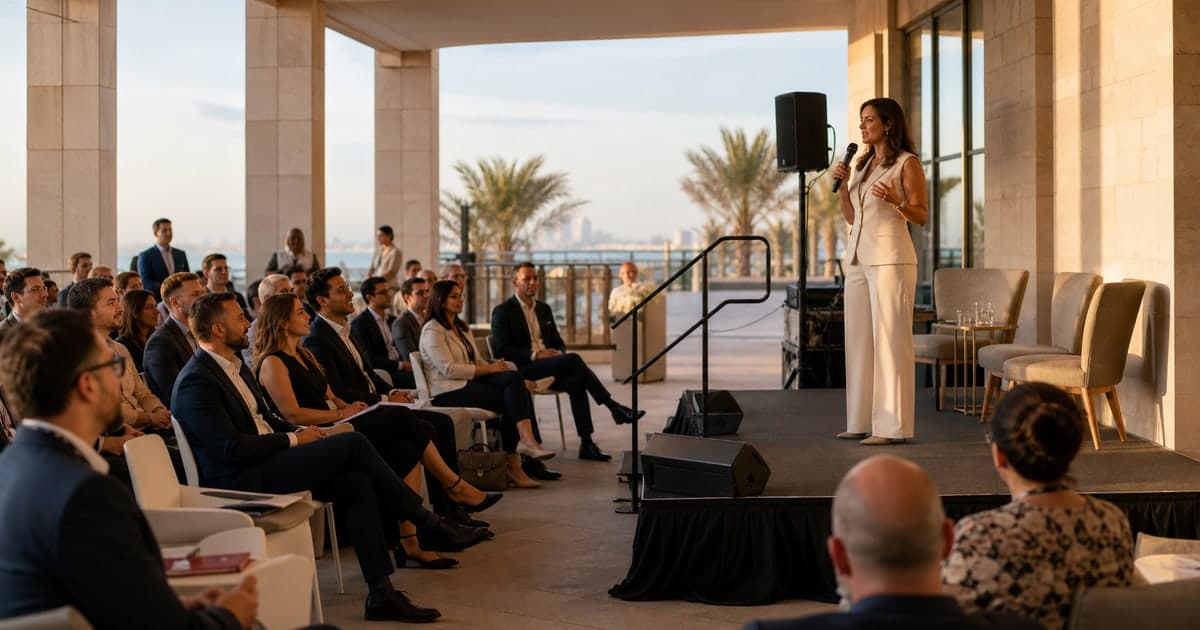
A bilingual MC in Dubai should plan English and Arabic around audience need and programme moment, rather than repeat every line in both languages. I don't work from a fixed language split, and I don't assume language preference from nationality or identity. I look at who needs to understand each moment, where formality matters, and which parts genuinely benefit from both languages. The aim is one coherent programme with one rhythm. For the wider language system beyond the host role, see my UAE bilingual event-hosting planner guide.
I Decide the Flow Moment by Moment
I start with the people in the room and the purpose of each segment. That is more useful than deciding in advance that an event should have a particular percentage of English and Arabic.
I want to know which guests need each language, whether the programme is mainly English led or Arabic led, and where everyone needs the same information. Then I look at the running order. A welcome, housekeeping instruction, speaker introduction, award presentation, formal acknowledgement and closing do not automatically need the same language treatment.
What matters is that each choice has a reason. If I can explain why Arabic is useful here, why English leads there, and why a particular instruction needs both, the flow usually feels more natural.
I Don't Repeat Every Line Twice
Line-by-line repetition can sound thorough on paper, but on stage it may make a programme feel slower than it needs to be. Guests hear the same idea twice, transitions grow longer, and the event can start to feel as though it is restarting after every sentence.
I prefer to decide where using both languages adds value and where it does not. An important instruction may need both. A formal welcome may benefit from both. A simple transition into a video may be perfectly clear in one language if the audience brief supports that choice.
This also keeps the MC role distinct from interpretation. Hosting means guiding the live programme, maintaining continuity, introducing people correctly, protecting the pace, reading the room and responding when timing or sequence changes. Interpretation is a specialist language service with a different purpose.
I'm not trying to demonstrate bilingual ability by saying everything twice. I'm trying to make sure the audience receives what it needs without allowing the mechanics of two languages to dominate the event.
Stage-Ready Bilingual Hosting Is More Than Fluency
Speaking English and Arabic comfortably is only the starting point. Stage-ready bilingual hosting means being able to think, adjust and recover in both languages while still sounding like one host leading one programme.
Preparation matters. I rehearse names, titles, acknowledgements, key transitions and wording that carries particular formality. I want to know which phrases are fixed, which can be adapted, and which details need approval before show day.
I also pay attention to how language sounds aloud. Written copy can be correct and still feel stiff on stage. A transition that works naturally in English may need a different sentence shape in Arabic. I am looking for equivalent clarity and tone, not literal symmetry.
Then there is the live judgement. Timing changes. A speaker may finish early. A handover may take longer than planned. The next segment may need a shorter introduction because the programme is running late. I need to adjust in either language without losing the structure or making the switch itself feel distracting.
Formal, Hybrid and Specialist Boundaries Matter
Formal programmes need tighter preparation around names, titles, honorifics, acknowledgement order and protocol wording. I ask the planner, client or designated protocol owner to confirm those details. I can prepare and deliver the agreed form accurately, but I should not be inventing protocol decisions backstage.
Dubai's official Government Communication Guide addresses language appropriate to the target public and careful handling of titles and protocol in government communication. It is useful context for formal communication, but it does not mean every private event requires a bilingual MC.
The boundaries need to be equally clear elsewhere. Protocol owners approve formal requirements. Interpretation, captioning and accessibility support are specialist roles when required. Production owns the technical environment for physical, online or hybrid delivery. The client or organiser owns programme and access decisions. My role is to host within that agreed structure and keep the live English and Arabic flow coherent.
For a hybrid event, that may include hosting people in the room and online. It does not automatically make the MC the interpreter, captioning provider, accessibility specialist or technical producer.
What I Need in the Booking Brief
A useful booking brief does not need to be complicated. It needs to tell me enough about the audience, programme and formal requirements to judge whether one bilingual MC is the right fit and how the hosting should work.
- Who will be in the room and which languages they genuinely need.
- Whether the programme is mainly English led, Arabic led or mixed throughout.
- Which moments need both languages and which can stay in one.
- Which names, titles, honorifics and acknowledgements require approval.
- Whether VIP, official or protocol requirements affect the running order.
- Who owns the script and where the MC is expected to refine or adapt it.
- What rehearsal time is available and where live programme changes are most likely.
- Whether hybrid elements, interpretation, captioning or accessibility support sit alongside the MC role.
That brief gives me a practical basis for preparing the language flow before show day while leaving enough flexibility to respond to the room once the event is live.
If you're deciding whether one bilingual host fits your event, share the audience, programme, language priorities and formal requirements through my bilingual MC service. I can then shape the English and Arabic hosting around the event you're actually planning.
Rima Iskandarani
Professional bilingual Events MC based in Dubai with 10+ years of experience hosting 150+ corporate, government, and entertainment events across the GCC.
Related Articles
Event Planning
Bilingual English and Arabic Event Hosting in the UAE: A Planner's Guide
Rima explains how to plan English and Arabic event flow in the UAE: audience needs, hosting models, interpretation, run-of-show decisions, approvals, and rehearsal.
Hiring an MC
How to Choose the Right Corporate Event MC in Dubai
Rima explains how to choose a corporate event MC in Dubai by matching the host to the room, audience, format, moderation, language, rehearsal, and production brief.
Event Planning
Government Event MC in Dubai: What Planners Should Know
How Rima prepares to host a formal government or semi-government event in Dubai: approved names, bilingual wording, protocol cues, rehearsal, and live updates.
Event Planning
What Does a Professional Event MC Actually Do?
A professional event MC guides the audience-facing program while coordinating timing, speakers, transitions, and live changes with the event team.