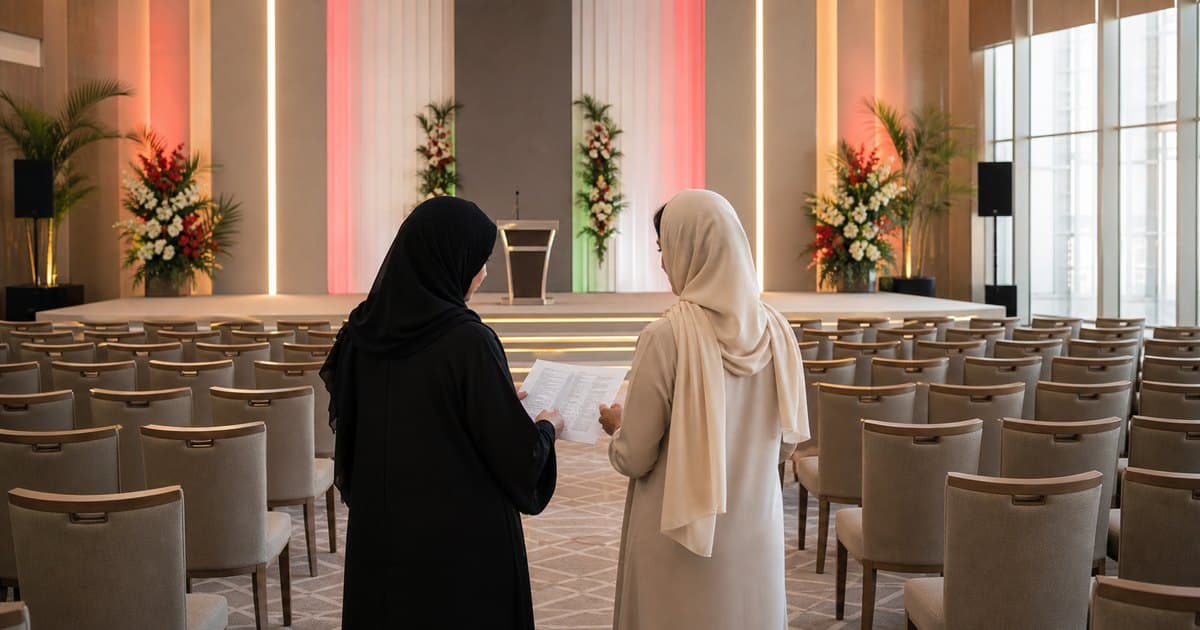
A UAE National Day ceremony works best when the organiser approves one clear programme, one bilingual language route, and one person for live changes before the MC rehearses. I treat the welcome, acknowledgements, ceremonial cues, performances, and close as one event, not as separate English and Arabic scripts stitched together at the lectern.
I hear the difference first in rehearsal. A line that looks balanced on the page can sound repetitive at the microphone, and a formal moment can lose its pace while the MC waits for a cue that nobody owns. When every line has a purpose and every cue has an owner, the room can stay with the ceremony.
Begin with the meaning of the room
UAE National Day is officially celebrated as Eid Al Etihad on 2 December. Before I write an opening, I ask what this particular gathering is meant to do. A government ceremony, an office celebration, a public festival, and a school programme may share the occasion, but they do not need the same voice or pace.
I want to know who is in the room, why they have gathered, and what they should feel at the end. Are we welcoming officials, employees, families, international guests, or a mixed audience? Is the programme formal throughout, or does it move from ceremony into community activities and entertainment?
The official celebration guides provide planning ideas and resources for organisations, schools, and families. I use those official materials as a reference, then work from the event team's approved brief. I do not turn last year's theme, artwork, or wording into this year's script.
Give English and Arabic different jobs
A bilingual ceremony is not automatically stronger because every sentence appears twice. It is stronger when both languages help the same room follow the moment.
I may open in Arabic because the occasion and audience call for it, then welcome international guests in English. A formal acknowledgement may stay in its approved Arabic form. A speaker introduction may move into English because that is the speaker's working language. The close can bring both audiences together without replaying the full programme.
The organiser decides which wording is official, which names and titles are approved, and which lines must remain fixed. I shape the pace, pauses, pronunciation notes, and transitions around that material. My bilingual event planning guide explains how to assign Arabic, English, interpretation, and specialist content before the script grows.
If one person is hosting both languages, I also want to hear the switches aloud. A line can look balanced on a page and still sound heavy in the room. My wider English and Arabic MC guide shows how I decide whether a switch adds inclusion, clarity, or emotional weight.
Build one ceremony sequence
I start with the audience journey, then place each stage moment inside it. Guests need to know that the ceremony has begun, why they are there, what is expected of them, and where their attention should go next.
The opening establishes tone and gives any essential audience instruction. Approved acknowledgements follow in the order provided by the authorised team. Ceremonial moments, speeches, films, performances, recognition, and the close then sit in a sequence that gives each one enough space without letting the room go quiet between them.
I mark who releases every segment. If a film follows a speech, I need to know whether the speaker clears the stage first and whether I speak over the reset. If a cultural performance enters through the audience, the aisle must be clear before I introduce it. If a senior guest joins later than planned, the programme needs an approved place to receive that change.
My government event hosting method is useful here. Names, titles, precedence, language, graphics, and stage cues should come from the same current version, not from five separate message threads.
Rehearse the ceremony in the actual room
The first room rehearsal usually answers questions that the document cannot. I walk the route to the microphone, check the lectern height, find my sightline to the show caller, test the pronunciation of names at performance pace, and confirm what the audience will see while I am speaking.
National-symbol and formal protocol moments receive a separate check with the authorised team. Dubai Protocol identifies precedence as a starting point for decisions about introductions, seating, gifting, and ceremony, and publishes guidance on the UAE flag. My role is to rehearse and deliver the approved event treatment, not to decide it from the microphone.
I also rehearse silence. Where will applause breathe? When does the music finish? Can the next speaker reach the stage before I say the final word of the introduction? Those small gaps are where a formal ceremony either feels composed or begins to feel improvised.
Hand the MC one final working brief
Before doors open, I want one document that I can trust on stage. It does not need to be beautiful. It needs to be current, readable, and owned.
- Event purpose, audience, level of formality, and current-year Eid Al Etihad materials
- Approved names, titles, acknowledgement order, and pronunciation audio where needed
- English, Arabic, bilingual, and interpreted sections marked clearly
- Fixed wording, adaptable transitions, and named language approvers
- Stage, AV, music, film, performance, and audience cues beside each segment
- One show caller and one route for approved live changes
- Rehearsal time for the room, not only a script read-through
- Final file name, version time, and confirmation that every team is using it
In rehearsal, I listen for the small break that would pull the audience out of the occasion: an outdated title, an untranslated cue, or a film starting before the stage is clear. Catching it there lets the audience stay with the ceremony itself.
Rima Iskandarani
Professional bilingual Events MC based in Dubai with 10+ years of experience hosting 150+ corporate, government, and entertainment events across the GCC.
Related Articles
Event Planning
Government Event MC in Dubai: What Planners Should Know
How Rima prepares to host a formal government or semi-government event in Dubai: approved names, bilingual wording, protocol cues, rehearsal, and live updates.
Event Planning
Bilingual English and Arabic Event Hosting in the UAE: A Planner's Guide
Rima explains how to plan English and Arabic event flow in the UAE: audience needs, hosting models, interpretation, run-of-show decisions, approvals, and rehearsal.
Event Planning
Bilingual MC in Dubai: English and Arabic Event Hosting
A bilingual MC in Dubai plans when English, Arabic, or both will serve the audience and keeps the program moving without repeating every line.