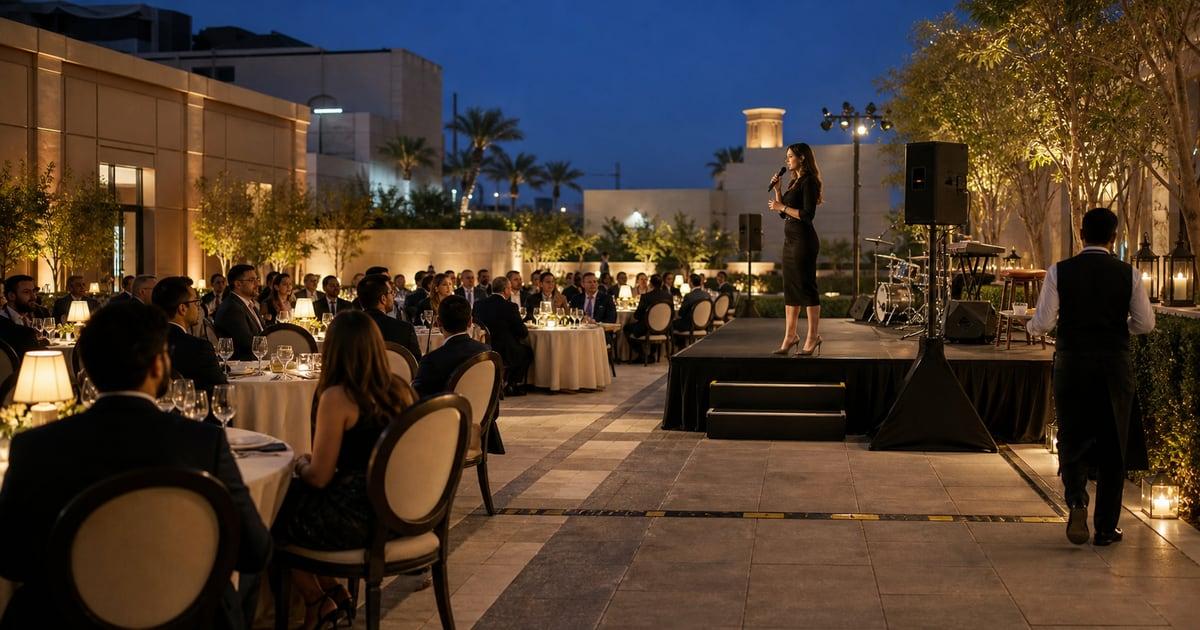
A gala dinner agenda should not treat dinner, speeches, awards, and entertainment as separate blocks competing for the same room. I pace them around what guests are doing at the tables, what service needs next, what the stage team can reset, and what deserves the audience's full attention. The best sequence is not always the shortest. It is the one in which every live moment has room to land.
For me, the working agenda starts with the guest experience, then adds owners and recovery choices behind it.
Dinner service is part of the programme
At a gala, the audience is also eating, talking, moving, and being served. A speech that begins while plates are being cleared competes with cutlery and staff movement. An award that calls guests across a busy service aisle creates a different problem. The run of show has to include those realities.
I meet the banquet or catering lead before the room opens and confirm the actual service pattern. Which course needs the quietest window? Which tables are served first? When will staff cross the main aisle? What is the signal that the room is ready for the next stage moment? The answer should come from the team delivering that event, not from a generic minute count.
ICC Belfast's gala-planning guidance places catering before the stage and audience-address decisions. On the microphone, I turn that sequence into when I hold, when I speak, and when I leave the room alone.
I give each moment a clear audience job
Every item needs an audience job. A welcome settles the room, an award creates recognition, and entertainment changes the energy. If two consecutive items ask for the same attention, the programme is repeating itself.
I use the transition thinking in the one detail planners often forget. I do not only connect words. I connect the audience's attention to the stage move, lighting change, meal state, and person who appears next.
I make sure I know which moments are protected and which can flex. A required acknowledgement may be fixed. A long presenter biography may not be. I ask the organiser to name that boundary before the event so a timing decision does not become a backstage negotiation.
A practical gala dinner pacing table
This example uses programme phases rather than fixed clock times because venue, menu, guest count, service style, and ceremony scope change the real timing. The owner and recovery columns matter as much as the running order.
- Dinner moment
- Welcome and first course
- What the room needs
- Settle, orient, then let service work
- MC job
- Welcome briefly and release the room
- Live owner
- Event lead and banquet lead
- If the evening is late
- Shorten orientation, not required acknowledgements
- Dinner moment
- Speeches between courses
- What the room needs
- Quiet tables and a ready speaker
- MC job
- Frame purpose, introduce, protect the handoff
- Live owner
- Content owner and stage manager
- If the evening is late
- Cut biography or combine thanks with the transition
- Dinner moment
- Awards after the main course
- What the room needs
- Clear aisles, names ready, trophies in order
- MC job
- Announce accurately and hold each recognition moment
- Live owner
- Awards lead and show caller
- If the evening is late
- Reduce repeated setup, not the recipient's moment
- Dinner moment
- Entertainment and close
- What the room needs
- A deliberate energy change and clear final action
- MC job
- Reset attention, introduce the act, return for the close
- Live owner
- Entertainment lead and producer
- If the evening is late
- Use the approved shorter set or closing route
The table is a conversation tool, not a universal timetable. It forces the planner, service team, production team, content owners, and MC to agree on the same audience state.
I also mark what guests should be doing during each row: listening, eating, applauding, standing, watching, or moving to the stage. If a row asks for incompatible actions, I change the sequence. Servers cannot clear safely while recipients cross the same aisle, and a speaker cannot hold attention while guests are finding seats.
I watch the room, not only the clock
The run sheet may say the speech can begin, but the room may still be receiving a course. I watch the service flow, the speaker position, the volume of table conversation, and whether guests can see the stage. A delay of one minute can be better than asking for attention twice.
When the programme is already behind, I start with the changes guests are least likely to feel. I tighten my own links, remove repeated context, and coordinate a faster stage reset. My guide to recovering a late event schedule explains why cutting a headline moment is not my first move.
Entertainment needs the same judgment. A band may require a real changeover, not a line in a document. A performance may need the room darker, the aisle clear, or guests turned toward a different focal point. I confirm that transition in rehearsal rather than discovering it after I announce the act.
The final brief should expose every dependency
Before doors, I want one current agenda that names the live owners and shows who can shorten, delay, move, or approve each flexible moment.
I keep the live brief concise. Menu details, full biographies, and technical patches can stay in their owner files. The agenda needs the current cue, decision, owner, and audience consequence. When something changes, everyone should see the same version.
The number of speeches, awards, languages, rehearsals, and production handoffs also changes the preparation behind an event MC quote. Sharing them early produces a more accurate scope and a stronger working relationship.
By the close, guests should have moved through dinner, speeches, awards, and entertainment without being pulled in two directions at once. When the programme respects both the occasion and the people living through it, the evening feels generous.
Rima Iskandarani
Professional bilingual Events MC based in Dubai with 10+ years of experience hosting 150+ corporate, government, and entertainment events across the GCC.
Related Articles
Hiring an MC
How Much Does It Cost to Hire an Event MC in Dubai?
Rima explains what shapes an event MC quote in Dubai, what a proposal can include, how to compare scope, and what to send before requesting a price.
Event Planning
The One Thing Every Event Planner Forgets: Transition Time
Rima explains how to build transition time into an event run sheet by listing the real changeover work, measuring it in rehearsal, and defining what ready means.
MC Stories
Why the Best Events Run Behind Schedule (and Nobody Notices)
See how Rima Iskandarani recovers a late Dubai event through tighter transitions, speaker cues, decision rights, and calm audience communication.