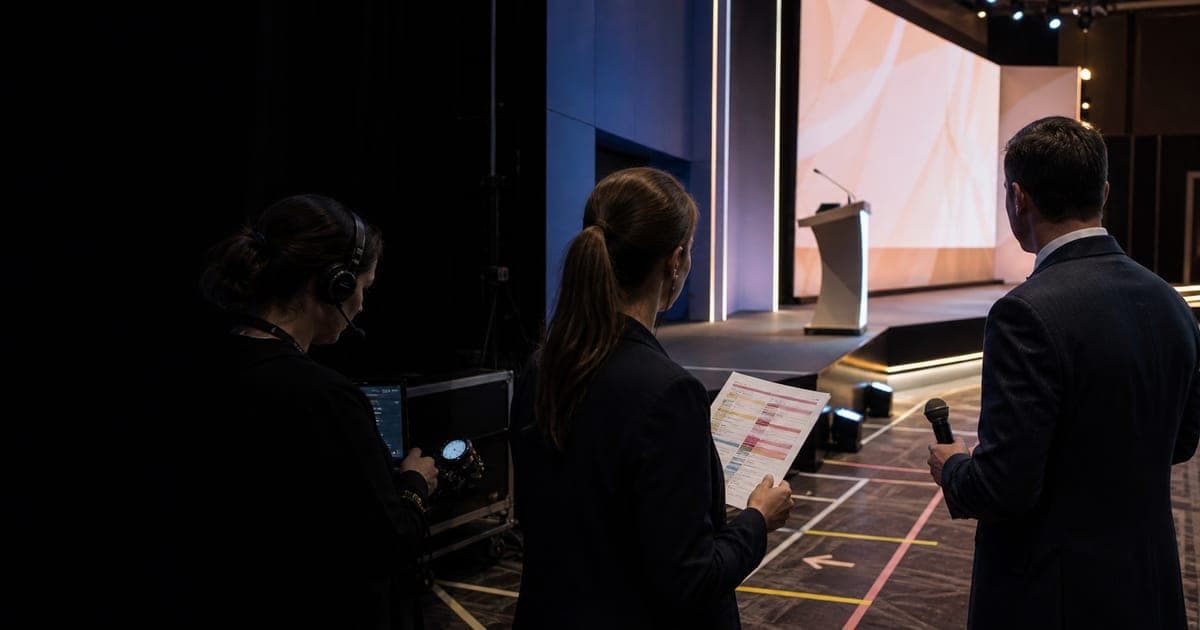
A keynote speaker lands the final line. The audience applauds. The next speaker is scheduled to begin immediately, but the first person is still leaving the stage, the microphone needs to change, the title slide hasn't switched, and the show caller hasn't given the next GO. That gap is transition time, and it belongs in the run sheet. If agenda items are scheduled back to back without time for the work between them, the programme can start running late even when every speaker finishes on time.
Transition time is the work between agenda items
Transition time is the practical time needed to move from one programme state to the next. It begins when the current segment releases and ends when the next segment is ready to start.
For a speaker change, that can mean applause, an exit, a walk-on, a microphone handoff, a slide change, lighting, and a cue. Awards may add the presenter, trophy, recipient route, pronunciation, photo position, and stage release. A panel may need chairs, microphones, seating order, moderator positioning, and a final technical check.
This is why I don't like a run-sheet line that simply says "changeover". I want to know what has to become true before I continue. The useful question is not, "Has enough time passed?" It is, "Is the next moment ready?"
Why back-to-back timings fail in a live room
On paper, 10:20 looks tidy. One session ends at 10:20 and the next begins at 10:20. Live events don't work that way.
Applause takes time. People need to leave and enter without crossing awkwardly. A lapel microphone may need to come off one speaker before another can use it. A video may need to clear before a holding slide appears. A panel can be physically on stage but still not be ready because a microphone channel is wrong or the moderator is waiting for a cue.
When those tasks are invisible in the schedule, the team starts borrowing time from the content. Pressure lands on speakers, the MC, AV, stage management, and the planner, even though the problem began in the run sheet.
My three-step way to plan a realistic changeover
Step 1: Define the trigger and the ready condition. Decide exactly what starts the transition, such as the speaker's final line or the end of a video. Then define what must be true before the next segment begins. That might mean the next speaker is on mark, the correct microphone is live, the approved title slide is visible, and the show caller has confirmed GO.
Step 2: Walk through the work in between. Follow the people, equipment, stage, screen, lighting, language, access, photography, and protocol tasks in the order they really happen. Notice what can happen at the same time and what depends on another action finishing first.
Step 3: Rehearse the handoff in the real setup where possible. Use the actual route, holding point, furniture, microphone plan, slides, and participants. The Encore presenter-preparation guidance is useful here because it includes entrances, introductions, room behaviour, videos, cues, and rehearsal timing as part of presenter preparation.
The aim isn't false precision. It's to make the hidden work visible so the schedule reflects what the team has to do.
Rehearse the details that make the handoff work
A good rehearsal doesn't stop after everyone has read their content. I want the closing line spoken, the applause space respected, the exit and entrance walked, the microphone change tested, the furniture moved, the correct slide called, and the release cue confirmed.
For interpreted or multilingual moments, the language plan also needs to be part of the transition. The International Association of Conference Interpreters recommends advance materials, appropriate equipment, coordination with the interpreter team and sound engineer, and timely notice of programme changes. Those are practical dependencies, not notes to discover during the show.
Rehearsal also reveals things a spreadsheet cannot. A presenter may reach the mark before the previous speaker has cleared. A panel may be seated while AV is still resolving a microphone. What matters is the whole handoff, not just the walk time.
My part as MC is the audience-facing bridge. I own the approved close, transition language, pronunciation, holding copy where agreed, and the release into the next segment. Stage management owns participant movement and stage readiness, AV owns technical states, venue teams own access and room operations, protocol and language owners confirm their specialist requirements, and the show caller integrates the ready signals when that role exists. I don't independently change those areas or call a technical GO that belongs to someone else.
My five-point pre-show check
Before I consider a transition ready for the live programme, I want these five things confirmed:
- The current participant knows the final line, exit route, and microphone action.
- The next participant is present, briefed, and at the correct holding point.
- Stage, audience, and accessible routes are clear for the handoff.
- Slides, video, lighting, microphones, furniture, awards, and language support are preset or cueable as required.
- The MC has the approved bridge and release line, and the correct owner knows when to confirm GO.
When those details are visible in the run sheet, transitions stop being gaps everyone hopes will somehow fit. I can keep the audience with me while the backstage team completes the work they own.
If the schedule has already slipped, I cover that separately in my guide to recovering an event schedule after a delay. If you're considering me for the event, you can also review my event hosting services. And if you already have a draft run sheet, share it with me. I can look at the transitions with you and flag the places where the paper timing may not match the live room.
Rima Iskandarani
Professional bilingual Events MC based in Dubai with 10+ years of experience hosting 150+ corporate, government, and entertainment events across the GCC.
Related Articles
MC Stories
Why the Best Events Run Behind Schedule (and Nobody Notices)
See how Rima Iskandarani recovers a late Dubai event through tighter transitions, speaker cues, decision rights, and calm audience communication.
Event Planning
Why I Always Ask About the Audience Before the Program
Rima explains the audience questions she asks before shaping an event program, from purpose and language to access, room dynamics, and live participation.
Event Planning
What Does a Professional Event MC Actually Do?
A professional event MC guides the audience-facing program while coordinating timing, speakers, transitions, and live changes with the event team.
Event Planning
Bilingual English and Arabic Event Hosting in the UAE: A Planner's Guide
Rima explains how to plan English and Arabic event flow in the UAE: audience needs, hosting models, interpretation, run-of-show decisions, approvals, and rehearsal.