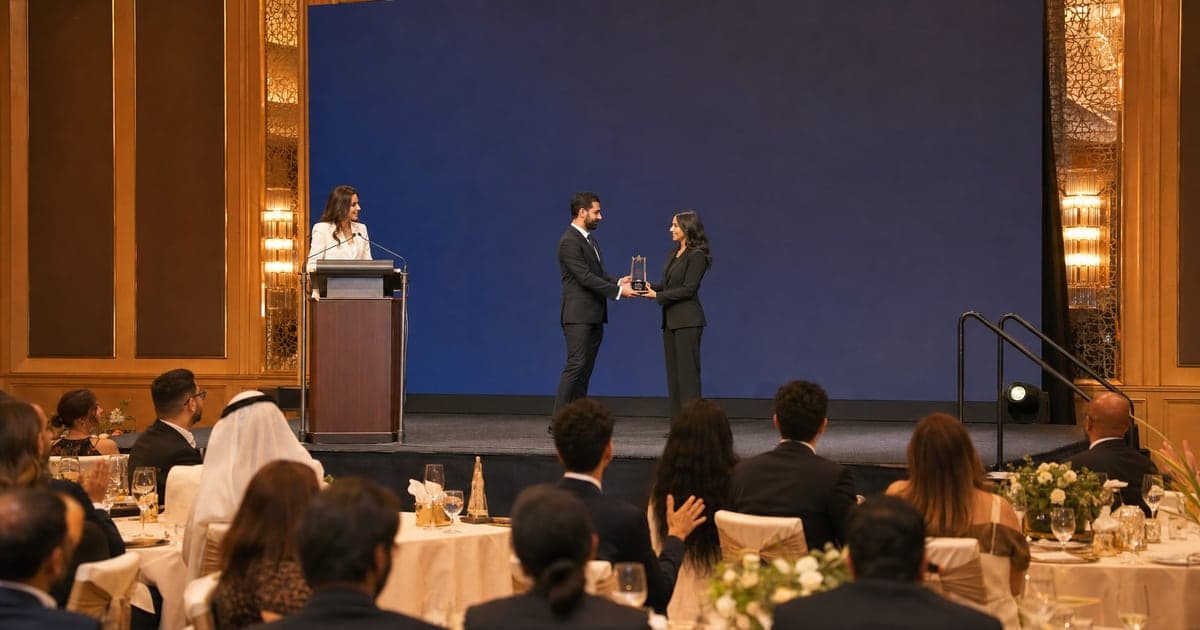
An awards ceremony programme works best when every category follows one clear sequence: establish what is being recognised, bring the presenter into position, announce the recipient accurately, complete the handoff and photo, then reset the stage before the next award begins. In a bilingual Dubai room, I also decide where Arabic and English each serve the audience. I do not simply repeat every line twice.
That repeatable shape gives the ceremony pace without making it feel mechanical. The audience can follow what matters, the recipient receives a complete moment, and the production team knows exactly when the stage is ready to move again.
I build one complete award unit first
Before I look at the full list, I build one award from start to finish. I want the approved award title, a short reason it matters, the presenter, the recipient reveal rule, the walk-on route, the trophy position, the photo position, any acceptance remarks, and the exit route.
When I walk through that first unit, I can see what the category list did not tell me. Is the presenter already on stage? Is the recipient coming from a table or backstage? Does the trophy arrive with the presenter or an usher? Will the screen reveal the name before I say it? If the answers do not agree, the audience will see the hesitation.
At rehearsal, I ask the presenter to face the audience for the handoff and hold the trophy where the recipient and photographer can both reach it. The meaning belongs in the words, but the room also needs to see the recognition clearly.
My bilingual awards sequence has six moves
I use the same six-move spine for each category, then adjust the language and tone to fit the room.
- Reset attention. I wait until the previous recipient, presenter, trophy, and camera move have cleared. The next award should not begin over an unfinished photo.
- Name the award and its meaning. I give the audience enough context to understand what is being recognised. I do not read a long criteria document from the stage.
- Bring in the presenter. I use the approved name and title, then hold the stage until the presenter reaches the correct mark.
- Announce the recipient. I follow the agreed reveal order and pronounce the full approved name without filling the moment with extra commentary.
- Protect the handoff. I leave room for the walk, applause, trophy exchange, handshake or greeting, and the planned photograph. If remarks are allowed, I release them clearly.
- Close and reset. I thank the right people, guide the exit, confirm the stage is clear, and only then open the next category.
The sequence is simple enough to repeat and flexible enough to carry different award types. It also gives the show caller six dependable cue points instead of one vague line marked "present award."
Arabic and English need assigned jobs
A bilingual ceremony becomes slow when every phrase is translated in full without asking who needs it. I may use Arabic for the formal category opening and local acknowledgement, then English for wider audience orientation. For another award, the recipient profile or presenter may make the opposite balance feel more natural.
The planner and content owner approve that route. I rehearse the switch so the two languages feel like one ceremony, not two versions competing for time. My bilingual event hosting guide explains how to assign a job to each language across the wider programme.
I do not invent formal Arabic on the day. Award titles, names, affiliations, and required acknowledgements need one approved source. If the English and Arabic files differ, that is a content decision to resolve before rehearsal.
Names and stage traffic deserve the same rehearsal
An award can be beautifully written and still fail at the name or the walk. I request phonetic notes and, where useful, a voice recording from the person or someone who knows the name. Toastmasters' guidance on name pronunciation recommends phonetic transcriptions, recordings, and practice rather than relying on spelling alone.
I then match every name to a seat, holding point, or backstage position. My article on pronouncing a long awards list covers the marking method; the programme must also tell me where to look and how long the walk will take.
During rehearsal, I stand where I will actually host. We practise the presenter's entrance, recipient route, trophy hand, photo mark, remarks, and exit. The lectern cannot block the handoff. The photographer cannot stand in the recipient's path. The next trophy cannot arrive while the current winner is still turning for the camera.
Pace comes from clean resets, not rushed recognition
When an awards section feels long, the instinct is often to make the MC speak faster. That saves very little and makes names, meaning, and bilingual delivery harder to follow. I first remove repeated wording, shorten presenter biographies, move group photos out of the live sequence where appropriate, and tighten the physical reset between categories.
PCMA's discussion of rethinking award presentations also recommends protecting audience value by speeding up or restructuring repeated presentation moments. The exact choice belongs to the organiser, but it should be decided before the room is waiting.
The scope also affects the preparation behind a professional quote, which is why the number of categories, languages, recipient confirmations, rehearsals, and script approvals belong in an early event MC cost discussion.
The category is complete when the recipient has had their full moment and the audience understands what comes next. Speed matters less than making that recognition feel whole.
Rima Iskandarani
Professional bilingual Events MC based in Dubai with 10+ years of experience hosting 150+ corporate, government, and entertainment events across the GCC.
Related Articles
MC Stories
The Art of Pronouncing 50 Names Correctly in One Night
Rima explains how she prepares 50 speaker, VIP, and award-recipient names with approved audio, a compact name sheet, live-sequence rehearsal, and change control.
Event Planning
Bilingual English and Arabic Event Hosting in the UAE: A Planner's Guide
Rima explains how to plan English and Arabic event flow in the UAE: audience needs, hosting models, interpretation, run-of-show decisions, approvals, and rehearsal.
Hiring an MC
How Much Does It Cost to Hire an Event MC in Dubai?
Rima explains what shapes an event MC quote in Dubai, what a proposal can include, how to compare scope, and what to send before requesting a price.