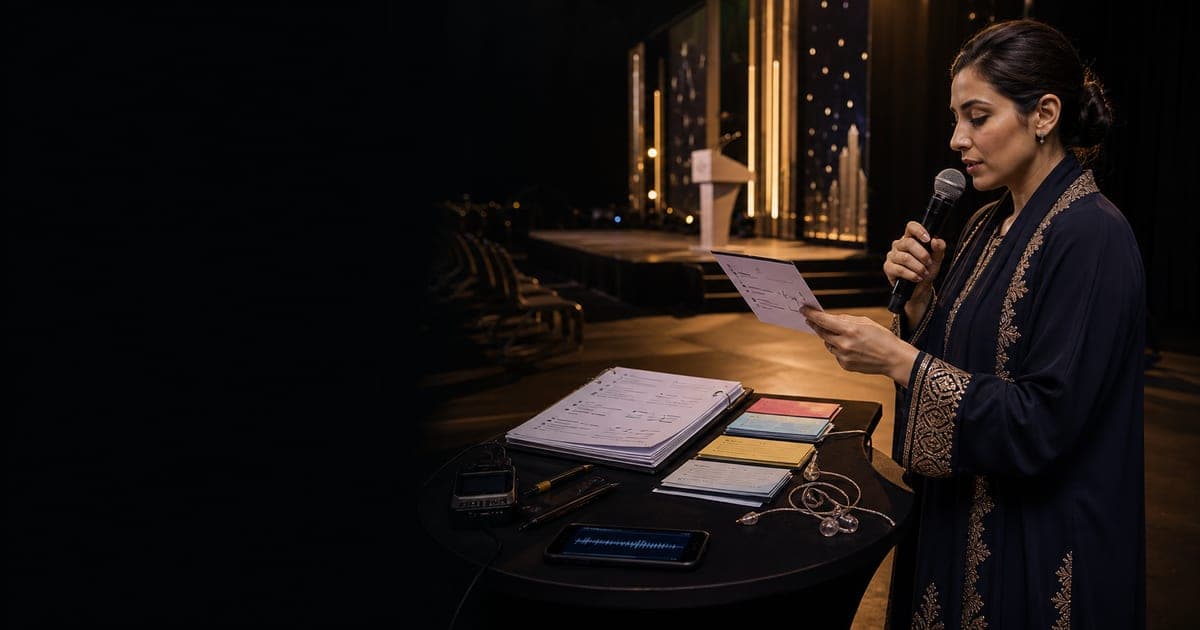
At an awards ceremony, the names do not arrive one at a time. They arrive in a sequence: category, presenter, nominee, winner, title, company, music, applause, walk-up, photograph, and the next card waiting behind it.
On a name-heavy night, I may introduce 30, 40, or 50 people. The challenge is not memorising a list. It is keeping every name accurate while the live order moves around me.
I want the public name each person has approved, an audio reference, a private cue I can read quickly, the correct title and affiliation, and one current order shared with production.
The audience hears each introduction for only a few seconds. Backstage, those seconds depend on careful collection, rehearsal, and version control.
A name is part of the show information
I never want to guess from spelling, nationality, language, a company biography, or another person with the same name. The written form may not tell me the stress, vowels, rhythm, or preferred public version. A legal name, badge name, public name, and stage name may also be different.
The strongest reference comes from the person. I ask for the exact name in writing and a short recording, once naturally and once more slowly. I confirm the title, affiliation, and introduction wording at the same time so I can practise the complete sentence.
Carnegie Mellon University's NameCoach workflow pairs recorded pronunciation with phonetic spelling. The University of Washington's inclusive name tools also emphasise pronunciation information, listening, and practice. For an event, I add the cue order and one authorised change owner.
The compact name sheet I use
Scattered voice notes are useful references, but they are not a live show document. I bring the essential information into one controlled sheet:
- What I record
- Cue ID, segment, and current order
- What ready means
- It matches the latest run of show
- What I record
- Approved public stage name and audio
- What ready means
- The person or authorised liaison has confirmed both
- What I record
- My private pronunciation cue
- What ready means
- I have tested it aloud against the approved audio
- What I record
- Title, affiliation, and introduction
- What ready means
- The copy matches the script, graphics, and award card
- What I record
- Change owner, version, and withdrawn record
- What ready means
- Everyone can identify the current row and the old one cannot return
The cue ID matters. Two similar names, a replacement, or a late order change can create confusion if the team refers only to the name. A number and segment give the producer, stage manager, graphics operator, and MC the same reference.
My phonetic cue is private working notation. It may use capital letters for stress, a pause mark, or a spelling that makes sense to my ear. It is not the authority. The approved audio is the test.
I rehearse the names as a live sequence
I do not practise 50 isolated words. I practise the event around them.
- Listen to the approved recording and repeat the full public name aloud.
- Add the title, affiliation, and introduction so the name sits in its real sentence.
- Rehearse small blocks, such as opening guests, speakers, award categories, and closing acknowledgements.
- Include the cue before and after the name: music, applause, walk-up, handoff, or photo mark.
- Run each block slowly for accuracy, then again at show pace.
- Do a cold pass from the current order after a break and reset any name that loses accuracy under pressure.
A name can sound correct alone and become awkward after a long title or company name. The full sentence reveals where I need a breath or a cleaner cue. The sequence also shows whether I am rushing because the music has started or looking at the wrong card because the order changed.
A late replacement needs a new record
A replacement is not just a new spelling. It can change the audio, title, affiliation, introduction, graphics, award card, music, walk-up position, and stage order.
I want production to create a new cue record and mark the old one withdrawn. The replacement goes through the same approval route, then the MC script, show-caller sheet, graphics, teleprompter, award card, and backstage list receive the current version.
Before that cue goes live, I repeat the exact name and cue back to the show caller. For a no-show, I wait for the approved skip, defer, or accept-on-behalf instruction. I do not announce that someone is walking to the stage until production has confirmed it, and I do not invent a reason for an absence.
If I get a name wrong
Preparation reduces preventable mistakes, but a respectful recovery still matters.
If I realise I have mispronounced a name, I correct it promptly and once: "My apologies, [approved name]." Then I continue the introduction. If the person corrects me, I thank them briefly, repeat the correct name, and return the attention to them.
I do not make a joke, explain why the name was difficult, ask the person to reassure me, or blame the script or team. After the segment, the source record is corrected so the same error does not travel to another presenter.
For an awards, gala, conference, or name-heavy programme, share the introduction brief before the final running order is locked. You can also compare this method with what to expect when you book Rima and her event portfolio.
Rima Iskandarani
Professional bilingual Events MC based in Dubai with 10+ years of experience hosting 150+ corporate, government, and entertainment events across the GCC.
Related Articles
Event Planning
Bilingual MC in Dubai: English and Arabic Event Hosting
A bilingual MC in Dubai plans when English, Arabic, or both will serve the audience and keeps the program moving without repeating every line.
Hiring an MC
How to Choose the Right Corporate Event MC in Dubai
Rima explains how to choose a corporate event MC in Dubai by matching the host to the room, audience, format, moderation, language, rehearsal, and production brief.
Event Planning
What Does a Professional Event MC Actually Do?
A professional event MC guides the audience-facing program while coordinating timing, speakers, transitions, and live changes with the event team.
Working With Rima
What to Expect When You Book Rima Iskandarani
See what happens after you contact Rima Iskandarani about a Dubai event, from the first brief and fit check through preparation, event day, and follow-up.