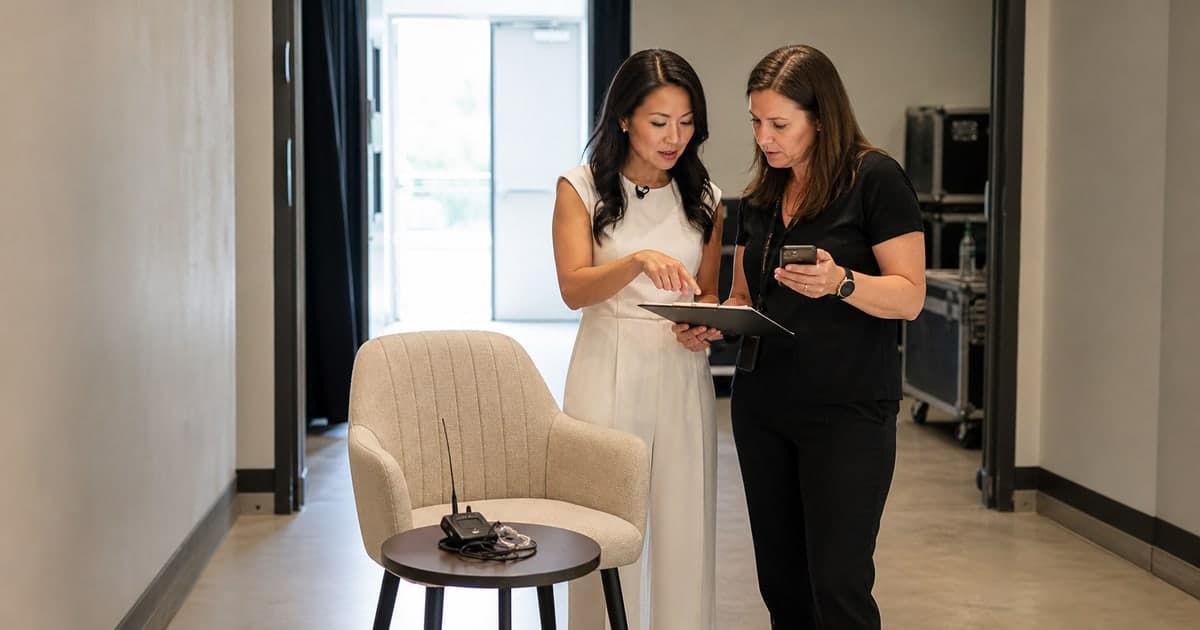
When a speaker cancels at the last minute, I do not rush on stage with the first replacement idea. I wait for the team to confirm what has changed, what the missing session was meant to achieve, and which fallback the client can approve. Then I give the audience one clear next step and help the new running order feel intentional.
What should happen first when a speaker cancels?
The speaker liaison should confirm whether the speaker has cancelled, is delayed, is still unconfirmed, or can join remotely. The producer and client then decide what happens to the session. The MC keeps the audience oriented, but should not announce a replacement while the facts and permissions are still changing.
“The speaker is not backstage” is not the same as “the speaker has cancelled.” A delayed arrival may call for a short reorder. A confirmed cancellation may remove a keynote, change a panel, or create a gap that cannot be filled with equivalent content.
I stay ready without adding another voice to the backstage debate. I mark the affected cue and prepare the audience wording the producer approves.
The five decisions I need from the team
Before I introduce a different segment, I need five answers:
- What is the speaker's confirmed status?
- What job was the session meant to do for the audience?
- Which fallback is approved and genuinely ready?
- What changes in timing, graphics, microphones, captions, interpretation, or remote delivery?
- What should the audience hear, and when should they hear it?
The fallback may be a remote appearance, an approved substitute, a shorter panel, a moderated conversation, a break, a later slot, or the clean removal of the segment. None of those is automatically right. A technical setup can be ready while the content, speaker, sponsor, rights, or protocol approval is not.
I ask the producer to treat the replacement as a new cue sequence, not a name swap. A shorter panel may need a new walk-on order and closing time. A remote speaker needs an audio check, a return monitor, and a clear handoff. Moving a break affects catering and room movement. Once the team chooses, I want one updated run sheet or one clearly marked live change, not three messages carrying different versions.
PCMA's main-stage contingency guidance gives practical examples of speakers joining remotely, substitute networks, recording permissions, and contingency terms agreed before the event. The point I take from it is preparation, not a universal replacement formula.
What I say to the audience
The audience does not need the whole backstage conversation. They need accurate orientation.
If the next approved segment is ready, I can move directly:
We are continuing with [confirmed segment]. Please welcome [approved speaker or moderator].
If the team needs a brief hold:
We are making an adjustment to the programme. Please stay with us, and I will guide you into the next confirmed session.
If the session has been removed, the wording should acknowledge the change without inventing a reason or blaming the absent speaker. I use the name, title, and explanation only as approved. Private travel, health, contractual, or personal detail does not belong in an improvised announcement.
For a bilingual programme, I confirm whether the same information must be delivered in English and Arabic, and whether the approved wording carries the same level of formality in both. A hurried translation can create a different promise, especially when the original speaker's title, replacement, or return time is still being confirmed.
I also avoid promising that the original session will return later unless the client has confirmed it. A hopeful sentence can create an expectation that the event cannot meet.
Prepare the alternative before event day
Planners can make this moment much easier by confirming a few practical items before doors open:
- One person verifies the speaker's status and one person approves the programme change.
- The session objective is written clearly enough that the team can judge alternatives against it.
- Remote joining has been tested for speakers who may need it.
- Substitute, recording, slide, and content-use permissions are covered in the brief or agreement.
- Flexible agenda items and the people who may move them are marked in the run sheet.
- Graphics, captions, interpretation, moderator notes, sponsor references, and attendee channels can be updated from one current plan.
Speaker agreements differ. The ICAEW speaker terms are one public example of a written brief covering presentation requirements, content approval, intellectual property, recordings, cancellations, and substitutes. A Dubai event should use its own appropriate agreement and advice, but the planning lesson is useful: decide these rights before the stage needs an answer.
I do not need every clause in my show file. I need the practical result: which alternatives are available, who approves them, and which words I can say in public. That keeps the agreement backstage while its preparation still protects the room.
What I can protect from the stage
If the change pushes the programme late, I use the approach in my schedule-recovery guide. If the speaker is present but the stage technology fails, the keynote AV guide covers that different pressure point.
A speaker cancellation is visible backstage before it is visible to the audience. Good preparation keeps it that way until the team has one accurate plan worth announcing.
Rima Iskandarani
Professional bilingual Events MC based in Dubai with 10+ years of experience hosting 150+ corporate, government, and entertainment events across the GCC.
Related Articles
Event Planning
What Does a Professional Event MC Actually Do?
A professional event MC guides the audience-facing program while coordinating timing, speakers, transitions, and live changes with the event team.
Working With Rima
What to Expect When You Book Rima Iskandarani
See what happens after you contact Rima Iskandarani about a Dubai event, from the first brief and fit check through preparation, event day, and follow-up.
MC Stories
Why the Best Events Run Behind Schedule (and Nobody Notices)
See how Rima Iskandarani recovers a late Dubai event through tighter transitions, speaker cues, decision rights, and calm audience communication.
MC Stories
What Happens When the AV System Crashes Mid-Keynote?
What Rima does when keynote AV fails: keep the room calm, follow the show cue, use truthful wording, and prepare a practical backup before doors open.