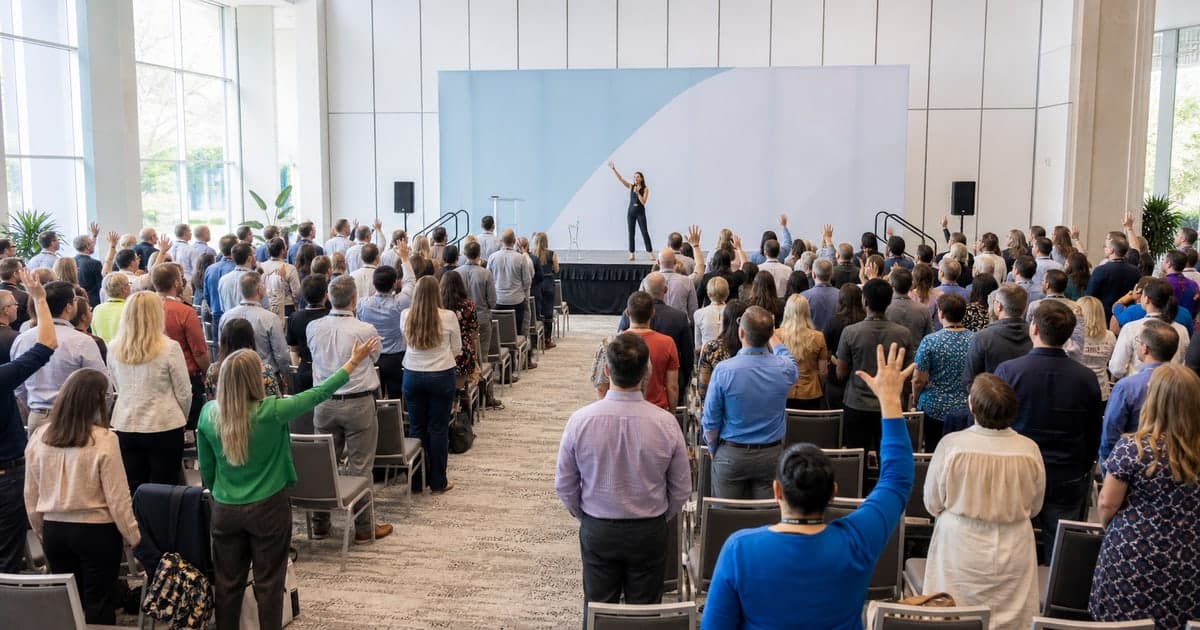
At a Dubai corporate conference, I once walked back into the hotel ballroom after lunch and could read the room before I reached the stage: phones in laps, shoulders relaxed, side conversations starting, and that soft post-buffet calm settling over the audience. I did not need to become louder or manufacture excitement. I needed a controlled reset: remove dead air, make the next session feel relevant, invite just enough participation, and hand over while attention was rising.
The smallest effective reset usually works best
After lunch, I start with the least intrusive intervention that can reconnect the audience with the programme. Sometimes that is a tighter transition and one clear sentence about why the next session matters. If the room needs more, I can add a show of hands, a short prompt, or movement if the setting suits it.
My sequence is simple:
- Observe. Read phones, posture, response speed, side conversations, and the overall feel of the room.
- Tighten the transition. Cut unnecessary housekeeping and avoid quiet gaps where attention can drift.
- State relevance. Give one clean reason the next session deserves the audience's attention.
- Invite brief participation. Use a show of hands, one question, or a very short neighbour prompt.
- Add movement only when the room suits it. Standing or stretching can help some groups and feel awkward in others.
- Hand over while attention is high. Introduce the speaker once the room is with me, not after the reset has gone on too long.
The point is not the activity itself. It is knowing when the room has had enough. A reset should support the session that follows, not become a separate performance.
Is every post-lunch audience actually tired?
No, and I do not treat the early afternoon as a guaranteed biological problem. The evidence is mixed. A 2024 Cardiff University study found no significant late-morning versus early-afternoon difference in the selective-attention and memory tasks it tested, and no significant difference between lunch and no-lunch groups in that study.
That boundary matters because an MC should respond to visible behaviour, not a cliché about what every audience must be feeling. I watch the room I actually have.
In Dubai, that room can be culturally and professionally mixed. You may have UAE-based teams, international delegates, GCC guests, senior executives, technical specialists, and bilingual moments within the same programme. The right reset depends as much on who is in front of me as on the time printed on the run sheet.
Senior rooms need polish, relaxed teams can take more participation
A senior or protocol-sensitive audience usually benefits from control. I may sharpen my vocal pace, shorten the transition, use a light line if the tone allows it, and make the next session's relevance clear. I would not force senior leaders into an energetic exercise simply because it is after lunch.
A more relaxed internal team can often take a more participatory reset. A quick show of hands, a neighbour exchange, or a short standing moment may feel natural because the culture of the room already allows it.
Language is part of that judgement too. In a bilingual English and Arabic setting, the reset should make people feel included rather than interrupt the flow. Sometimes a brief bridge in both languages helps bring the room back together. Sometimes one language is clearly right for that moment. The decision should serve the audience, not display the MC.
This is why I want to understand seniority, formality, language preference, and room culture before event day. Those details tell me how far I can push participation without losing trust.
Movement is a tool, not a rule
Movement can be useful, but I keep it optional. If the seating, dress, audience profile, and tone make standing comfortable, a short change in posture can add variety. If the room is formal, tightly packed, or visibly resistant, I leave it out.
The research does not justify treating movement as a guaranteed cognitive fix. A systematic review indexed by PubMed found positive cognitive effects in three of seven studies that interrupted prolonged sitting with activity, while describing the overall evidence as limited and mixed.
That is another reason to avoid a fixed script. A room may need movement, but it may just as easily need a cleaner verbal transition, better timing, or less technical silence.
The handover matters here. If I have just regained the audience, I do not keep talking until the energy drops again. I bring in the speaker while the room is ready to listen.
The afternoon should be designed before I reach the stage
The MC can rescue a weak transition, but the strongest afternoon programmes do not depend on rescue. I like to see the run sheet early enough to understand what comes immediately after lunch, how long the AV change takes, whether the first session is dense or conversational, and whether the room gives us flexibility.
PCMA's meeting-design guidance makes a similar point about treating the agenda as a journey and matching formats to the natural rhythm of audience energy. For planners, that means the first post-lunch slot should not be considered in isolation. Session format, transition length, speaker style, and the audience's relationship to the content all affect how much work the MC needs to do.
If you are choosing a host for a demanding Dubai conference programme, I would look beyond stage presence alone. The useful questions are whether the MC can read a room, adjust without embarrassing people, handle seniority and protocol, use English and Arabic with judgement, and know when to stop resetting and hand over.
My corporate event MC selection guide goes deeper into those hiring decisions. For a difficult afternoon agenda, the best outcome is not an MC who can make the room louder. It is an MC who can recognise what the room needs, use the smallest effective reset, and return attention to the programme at the right moment.
Rima Iskandarani
Professional bilingual Events MC based in Dubai with 10+ years of experience hosting 150+ corporate, government, and entertainment events across the GCC.
Related Articles
Hiring an MC
How to Choose the Right Corporate Event MC in Dubai
Rima explains how to choose a corporate event MC in Dubai by matching the host to the room, audience, format, moderation, language, rehearsal, and production brief.
Event Planning
What Does a Professional Event MC Actually Do?
A professional event MC guides the audience-facing program while coordinating timing, speakers, transitions, and live changes with the event team.
Event Planning
Why I Always Ask About the Audience Before the Program
Rima explains the audience questions she asks before shaping an event program, from purpose and language to access, room dynamics, and live participation.